After a Hard Winter: When Your Driveway Needs Repair — and When It Needs a Full Tear-Out
Freeze-thaw cycles and road salt leave driveways across Monroe and Lucas counties with new cracks every March. Experts explain when patching works, when it wastes money, and what a proper replacement includes.
By T1 Construction
The cracks that appeared overnight were years in the making
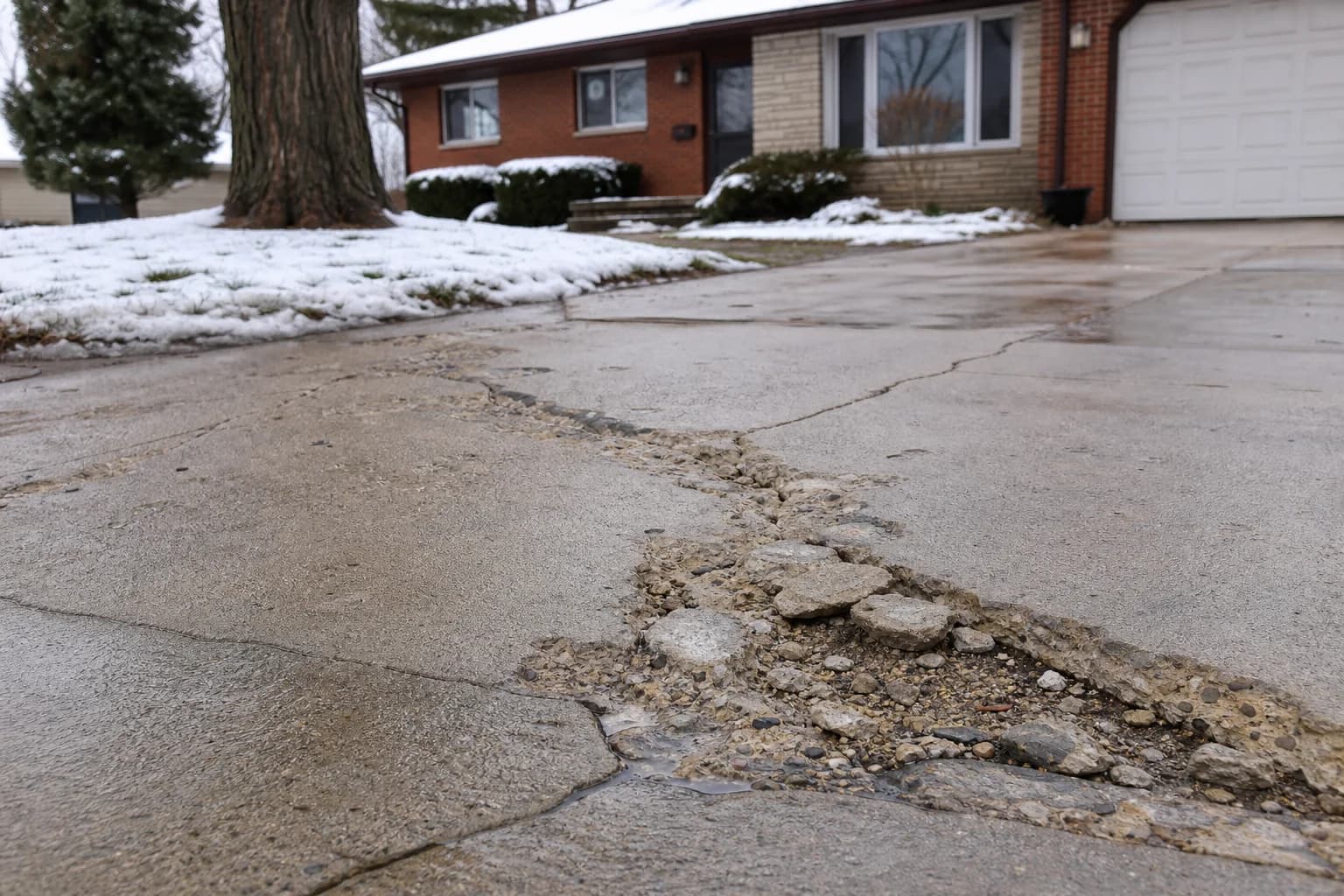
Every February, driveways that looked fine in October tell a different story. Hairline fractures widen into trip hazards. Chunks spall away where salt sat all winter. Aprons settle at the garage threshold, creating a lip that catches snowblower blades and bike tires. In Lambertville and Sylvania alike, the damage looks sudden. It rarely is.
Concrete fails from the bottom up and the inside out. A thin or poorly compacted aggregate base lets the slab flex under vehicle loads. Missing or misplaced control joints force random cracking. Inadequate air entrainment and wrong cure times leave concrete vulnerable to the freeze-thaw cycles that define border-region winters — dozens of times per season, water enters micro-cracks, freezes, expands, and pries the matrix apart.
Homeowners standing in their driveway with a cup of coffee ask the same question: patch it, or tear it out? The answer depends less on how bad it looks today and more on what is underneath — something only visible after careful evaluation or sometimes not until the old slab is gone.
When repair is the right call
Surface scaling, isolated spalls, and narrow cracks in an otherwise structurally sound slab can sometimes be addressed with patching, partial-depth repairs, or sealing — especially if the base is stable and drainage works. Joints that have opened slightly may need re-sealing before next winter. Small trip hazards at control joints can be ground or filled if the slab has not settled differentially.
Repairs make financial sense when less than roughly 15–20% of the surface is affected, when cracks are not actively moving, and when water is not pooling against the foundation or garage. Contractors who specialize in flatwork in Adrian and Maumee emphasize that honest repair recommendations build trust — telling a homeowner to patch when replacement is inevitable wastes everyone's money.
Even viable repairs should include a plan for drainage and salt management. Redirecting downspouts, fixing grade, and applying a quality sealer before November can extend a repaired driveway several seasons. None of that fixes a failed base, but it buys time when the structure beneath is still sound.
“Pouring new concrete over a failing base is the number-one shortcut we see — and we do not do it.”
When replacement is cheaper than throwing good money after bad
Full tear-out and replacement is the honest answer when cracks are wide and uneven, when the slab has heaved or settled in sections, when the base was clearly inadequate, or when previous overlays are delaminating. If water runs toward the house because the pitch was never correct, resurfacing the top does not solve the problem — regrading and rebuilding does.
Alligator cracking — a web of small interconnected fractures — usually indicates base failure or severe freeze damage throughout the slab, not a surface issue. Multiple previous patch jobs that are failing again signal the same thing. In those cases, patch quotes may look attractive in February but become sunk costs by the following summer.
A proper replacement includes breaking out and hauling away the old concrete, excavating to stable subgrade, installing compacted aggregate base at appropriate depth, placing reinforcement sized for vehicle loads, pouring with air-entrainment suited to local weather, saw-cutting control joints at correct spacing, and finishing with pitch that moves water away from structures. That sequence is why replacement costs more than a bag of patch mix — and why it lasts.
- Wide cracks with vertical displacement between sides
- Standing water or ice dams against the garage or foundation
- Sections that rock or sound hollow when driven over
- Repeated patch failures in the same area
- Alligator cracking across large portions of the slab
What border-region homeowners should expect to pay
In southeast Michigan and northwest Ohio, most driveway replacements run between $6 and $15 per square foot installed, depending on square footage, thickness, reinforcement, access for equipment, and finish type. Decorative stamped or colored work sits at the higher end. Tear-out of an existing slab, base rebuild, and haul-away are line items that separate serious quotes from vague ones.
Timing affects price and quality as much as scope. Late spring and early fall offer the best conditions for pour, cure, and joint cutting. Summer pours are workable with adjusted cure protocols. Winter pours are generally avoided for residential driveways unless conditions are carefully controlled — a detail worth confirming if anyone promises a February replacement in this climate.
Vehicle weight matters after a pour, too. Foot traffic is typically safe after 24 hours; passenger vehicles after about seven days; heavy trucks and RVs after 28 days. Rushing that timeline in cold weather is how new driveways fail before their first anniversary.
Salt, clay soil, and the details most quotes skip
Road salt and de-icers accelerate surface deterioration on concrete that was not sealed or was finished with the wrong mix for freeze exposure. Homeowners cannot control municipal salting on the street, but they can avoid piling salt on the apron and use sand or calcium alternatives where appropriate.
Clay soils common in Monroe and Lenawee counties expand and contract with moisture. Without proper base depth and compaction, that movement telegraphs through the slab. Reinforcement and joint layout must account for both soil movement and thermal expansion — two separate forces that amateur pours often ignore.
Before signing, ask how control joints will be placed, what reinforcement is included, and how the contractor handles cure time in your scheduled season. Ask whether tear-out and base prep are included or priced separately. Those details determine whether a driveway survives five winters or fifteen.
Frequently asked questions
Get an honest assessment before the spring rush
Not sure whether your driveway needs repair or replacement? T1 Construction evaluates existing flatwork across Monroe, Toledo, and surrounding border counties — and tells you when patching is enough and when it is not. Free on-site estimates with itemized scope, typically within 24 hours.